Local SEO for an auto repair shop comes down to a few basics: an accurate Google Business Profile, clear pages about the work you do, honest reviews, and an easy way for drivers to call or book. Below, we cover each one, plus the common reasons a shop doesn’t show up on Google and what to fix first.
Key Takeaways
- Google ranks local results on three main things: relevance, distance, and prominence.
- Your Google Business Profile is the anchor. Claim it, own it, and keep it accurate.
- Steady, recent reviews and thoughtful replies help both rankings and trust.
- Rankings only pay off if the phone gets answered and booking is easy.
Why SEO matters for a local repair shop
When someone needs their car fixed, they usually search Google or Google Maps first. Showing up near the top of those results works like a bigger sign out front: more people notice you. But a sign doesn’t answer the phone, so SEO is one part of filling the bays, not the whole job.
How does Google decide which repair shops show up first?
Google says local results are based mainly on relevance, distance, and prominence (Google Business Profile Help). Relevance is how well your profile and website match what the driver searched for. Distance is how close you are to them. Prominence is how well known and trusted your shop looks online, including your reviews and mentions around the web.
You can’t change where your shop is, but you can improve relevance and prominence. That’s the job of local SEO.
What happens if you ignore it?
The map results show only a few shops at a time, and many drivers call one of those before they scroll any further. If your listing is incomplete or your website doesn’t explain your services, you’re more likely to be left out. For the bigger picture beyond SEO, see how online marketing can grow your auto repair shop.
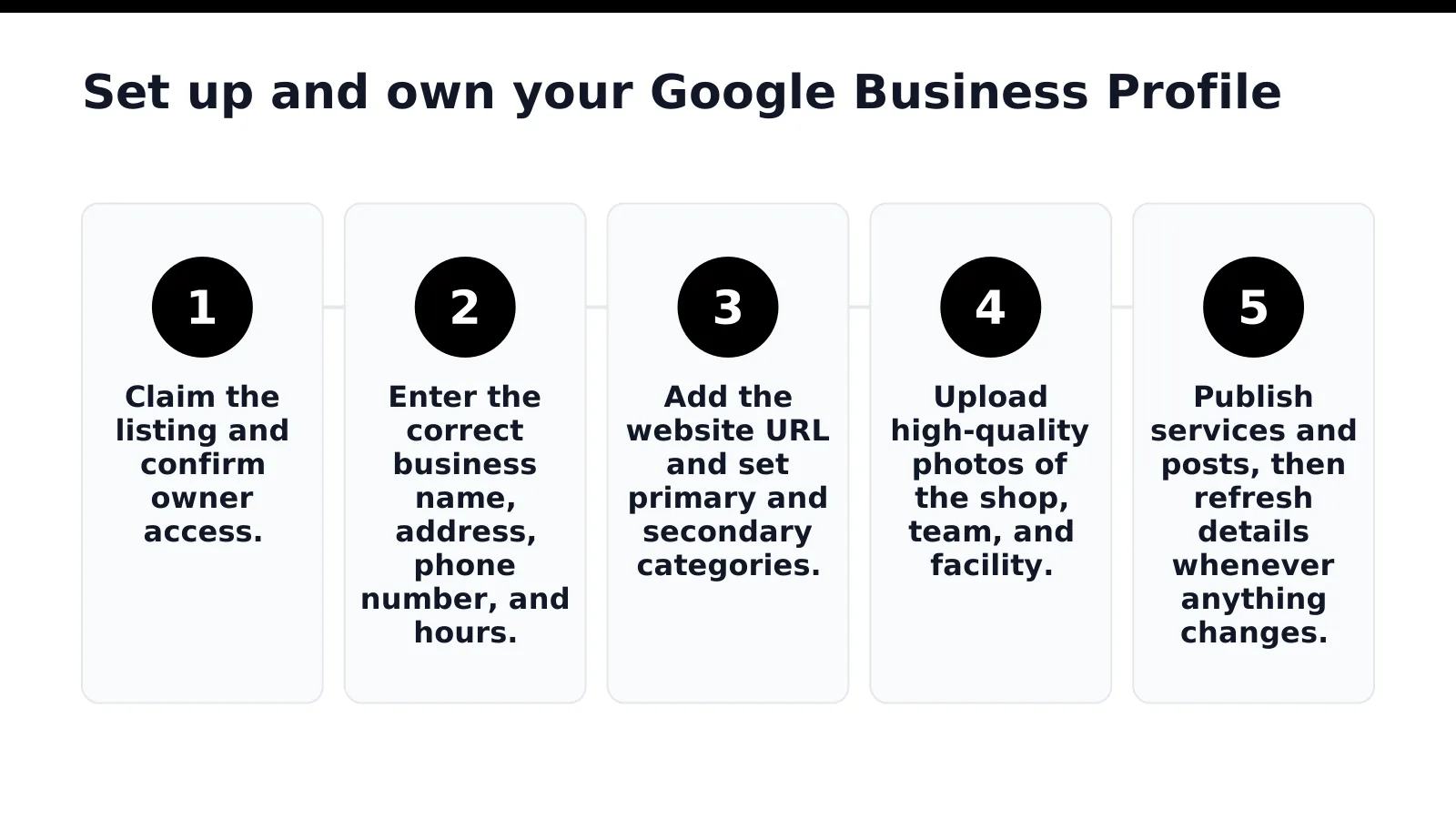
Set up and own your Google Business Profile
Accurate profile details help Google understand your shop and give drivers what they need to choose you. Google says businesses with complete and accurate information are more likely to show up in local results.
Ownership matters as much as accuracy. Claim the listing, keep owner access yourself, and give any vendor manager access instead of ownership.
Follow these steps to lock in the foundation
- Claim the listing and confirm owner access.
- Enter the correct business name, address, phone number, and hours.
- Add the website URL and set primary and secondary categories.
- Upload real photos of the shop, team, and facility.
- Add your services and post updates, then refresh details whenever anything changes.
In most U.S. states, Google can now call a shop on a driver’s behalf to ask about price and availability (Google Business Profile Help), which is one more reason your profile and phone details need to be right. Read more about Google’s AI calls to repair shops.
Reviews and review replies that help rankings
Reviews help in two ways. They’re part of how Google judges prominence, and they’re what drivers read before they call. A steady flow of honest, recent reviews tends to do more than a big batch of old ones.
How do reviews affect your ranking on Google Maps?
Google says more reviews and positive ratings can help a business’s local ranking, and drivers notice how recent reviews are. Google doesn’t publish exact weightings, so the practical goal is simple: keep good reviews coming in regularly and respond to them.
What makes a good review reply?
Thank the customer, mention the work in plain words (“Glad the brake job fixed that squeal”), and keep it human. Don’t stuff keywords into replies. Write for the next customer who reads it. For a negative review, stay calm, acknowledge the issue, and offer to talk directly.
A simple routine:
- Ask every customer for a review at pickup and follow up with a text that includes your review link.
- Reply to new reviews within a day or two.
- Report reviews that clearly break Google’s policies, like spam or reviews from people who were never customers.
Don’t offer discounts or gifts for reviews. Google’s review policy doesn’t allow it.
Your website: service pages, location pages, and speed
Your website backs up your profile. Service pages, location pages, and load speed all affect whether Google shows your site and whether drivers stay long enough to call.
What makes a service page effective?
Give each main repair its own page. A page titled “Brake Repair in [City]” gives Google a clearer signal than a general “Services” page that lists everything. Each page should explain the work, the vehicles you serve, and how to book.
If you have more than one location, give each one its own page with that shop’s name, address, phone number, and a map. That keeps things clear for both Google and customers.
How does website speed affect local search?
A slow site frustrates visitors, and many will go back to the search results. A few common fixes:
- Compress images so they load faster without looking worse.
- Remove plugins and scripts you don’t need.
- Turn on browser caching so returning visitors load pages faster.
A fast site that clearly describes each service and makes it easy to call or book helps turn more visitors into appointments.
Consistent listings: Yelp, Apple Maps, Bing, and other directories
Your shop’s name, address, and phone number should match everywhere it’s listed: Yelp, Apple Maps, Bing, and other directories. When details don’t match, search engines are less sure which information is right, and customers may get the wrong phone number or hours.
How do directory listings support your Google Business Profile?
Think of other listings as backup witnesses. When they agree with your Google profile, they back up your details instead of contradicting them.
What steps keep listings consistent?
- Claim your profiles on Yelp, Apple Maps, Bing Places, and the major directories.
- Write down your exact business name, address, and phone number in one master document.
- Update each listing to match that master record exactly.
- Recheck listings every few months and after any move, rebrand, or change in hours.
Why your shop isn’t showing on Google (common fixes)
When a shop doesn’t show up on Google, the cause is often simple. Run through these checks first:
- Your profile is verified, and the name, address, phone number, and hours are correct. Accurate listings are still the starting point for local search.
- Your primary category matches the work you want most.
- Your website has a page for each main repair, and Google can index it. Google Search Console, which is free, will show you.
- You’re judging results from where your customers are. Distance is a ranking factor, so results change across town.
How long does a profile cleanup take?
A basic cleanup can often be done in one sitting. Start with the profile fixes that matter most, then keep the profile up to date as things change.
Turning search traffic into booked cars
Showing up in search only pays off when drivers call and book, whether you fix cars, trucks, or motorcycles. Motorcycle shop owners can read more about the marketing challenges they face.
If you need more car count, look at the whole path from search to schedule before adding another marketing task.
How do you turn Google Maps views into appointments?
A complete profile with accurate hours, services, and photos removes guesswork. Drivers who find clear information are more likely to book. Drivers who get confused often call someone else.
- Put your phone number and a booking link where drivers see them first: on your profile and near the top of each service page.
- Respond quickly to every call, missed-call text, and online booking request.
- Track which searches lead to calls, and improve those service pages first.
What breaks the booking path most often?
Unanswered calls. A driver who reaches voicemail often calls the next shop on the list, so call your own line during a busy hour and after closing to hear what customers hear.
What to do yourself vs. what to hand off (and keep ownership)
Some SEO work is best kept close to the shop, and some is easier to hand to someone with the tools and time. The key is knowing which is which, and keeping ownership of your accounts either way.
What should you keep in-house?
Stay in charge of how calls are answered and booked. Whether your team answers, or you use an AI receptionist or missed-call text-back to cover busy times and after hours, you decide the script and make sure every caller gets a response. Nobody cares about your reputation the way your own team does.
What can you safely hand off?
Technical work and content are good candidates. SEO takes ongoing keyword research, page updates, and performance checks that pull owners away from the shop floor. A provider can handle profile posting, directory cleanup, and site fixes while you keep the shop’s voice and the final say.
Keep in-house:
- Answering calls and scheduling appointments, or choosing and checking the system that does
- Replying to customer reviews in your own voice
- Taking photos of real work and the shop
- Deciding your service area and how you describe your services
Hand off if you’d like:
- Keyword research and content planning
- Technical site audits and page-speed fixes
- Google Business Profile posts and photo updates
- Directory listing cleanup and accuracy checks
The dividing line is simple. Keep anything that needs real-time customer contact or firsthand shop knowledge. Hand off the repetitive work that needs special tools and regular monitoring.
FAQ: SEO questions shop owners ask
How quickly can a shop start its own SEO plan?
Today. Start by checking your Google Business Profile for accuracy, then list the repairs you want more of and see which ones don’t have their own page yet. Results take time to build, but the first fixes cost nothing.
Where does AI fit in?
AI tools can help draft service pages, suggest review replies, and answer common questions. AI search tools are also another way drivers find shops. The same basics that help in Google (clear service pages, consistent listings, and real reviews) help you show up there too. Read more about showing up in AI search.
In Closing
Auto repair shop SEO isn’t a one-time project. Start with a profile check this week, work down the list, and watch your phone as closely as your rankings. To see how calls, estimates, and repeat customers fit in, read Auto Repair Shop Marketing: What Actually Brings Cars Into Your Bays.
If you’d rather hand off the website and content side, America’s Best Shops’ SEO/AEO service covers that work, and our Local Visibility Engine keeps your Google Business Profile and listings accurate.

Brad Killgore is a Best Selling Author, Speaker, Military Veteran, and Strategic Marketing Expert with over 18 years of experience in the industry. Brad loves to spend time with his family and 3 grandchildren. He is an avid traveler who previously lived full-time with his wife in their luxury RV for 3 years. He has worked on some of the biggest concert stages in the world and met some of the most famous Rock Stars on the planet. Brad is a car and motorcycle enthusiast who has attended thousands of concerts over the last 45 years. Brad has been featured on top media outlets for his outstanding marketing results for America’s Best Shops. Brad is a Trailblazer in the world of AI strategy and automation.