Think about what is sitting unfinished in your shop right now. There is a review nobody answered, an estimate nobody followed up on, and an inbox that can swallow your morning before the repair work even starts.
I tested an AI agent for repair shops by handing it a chunk of that work for a week. The rule was simple: nothing went out without my approval. The agent helped prepare the work. It did not get to make decisions for the shop.
The same approach works whether you run an independent auto repair shop, a collision center, a tire and brake business, or a diesel, truck, or RV repair operation. AI can help with the pile on your desk, but somebody still has to check what it produces.
Treat an AI Agent for Repair Shops as an Assistant, Not the Manager
When you are in the bay all day, customer communication tends to get pushed aside. Review replies wait until tonight. Estimate follow-ups wait until tomorrow. Sometimes neither happens.
The trouble is that those tasks are connected to real customers. An estimate that never gets a follow-up can become a customer who takes the work somewhere else. An unanswered message stays unanswered even if your reason is perfectly understandable.
An AI agent, such as the Grok Bot example I tried, is best treated as an assistant that can keep preparing that work while you are under a vehicle or handling the next problem at the counter.
The useful handoff is preparation, not authority. Let the agent draft, sort, and suggest. Keep the decisions about what gets sent, what gets promised, and what gets booked with the owner or manager.
That is a more practical starting point than trying to automate the whole shop. You are giving a defined task to an assistant, then checking the result before it reaches a customer.
Five Busywork Tasks an AI Agent Can Help Prepare
The work I handed off fell into five areas. None required turning over control of customer relationships. Each gave me something to review instead of another blank page to start from.
1. Review Replies
The agent drafted replies to reviews: a thank-you for the positive ones and a calm response for the negative ones. Every reply still needed approval before it was posted.
For a good review, the task is straightforward. Acknowledge the customer and make sure the response sounds like your shop. A draft is a starting point, not a reason to publish wording you would never use yourself.
Negative reviews need more care. A calm draft can help you avoid starting from frustration, but the agent does not take responsibility for the response. You still need to read it, understand the situation, and decide whether the wording fits.
If you manage reviews through Google, its guidance on replying to reviews provides a reference for the posting process. The judgment about what to say remains yours.
2. Estimate Follow-Ups
The agent identified estimates that had not received a response and drafted a friendly follow-up. I read each message before it went anywhere.
This is a useful place to start because the task is clear. You are not asking AI to sell a repair on its own. You are asking it to prepare a nudge so an unfinished conversation does not disappear into the daily pile.
The follow-up should remain consistent with the estimate and your shop’s rules. If the draft starts making promises or introducing pricing language you did not authorize, it needs to be edited or discarded.
3. Service Reminders and Suggested Openings
The agent drafted service reminders and suggested open slots. It did not run the calendar. Nothing got booked without me.
Preparing a reminder is one task. Committing the shop to an appointment is another. A suggested opening still needs your review before it becomes a promise to a customer.
Keep those two actions separate in your process. The agent can prepare the communication and the suggestion. The person responsible for the calendar decides whether the booking should happen.
4. Social Post Drafts
The agent wrote first drafts based on what was happening at the shop. I adjusted them so they sounded like us, not like a robot.
That is the right role for AI in repair shop marketing: help turn real shop activity into a draft, then let somebody who knows the business shape the final wording.
Your voice still matters. If you would not say something at the service counter, do not publish it just because the draft reads smoothly. A polished sentence is not automatically the right sentence for your business.
5. Inbox Sorting and Reply Drafts
The agent separated urgent messages from junk and drafted responses. That let me focus on the messages that mattered instead of starting with the whole inbox.
Sorting and drafting are different from resolving an issue. A message can be identified as important without the agent being qualified to decide what should happen next.
Use the prepared replies as a starting point. Anything involving an upset customer or money still needs your own attention, no matter how routine the message initially looks.
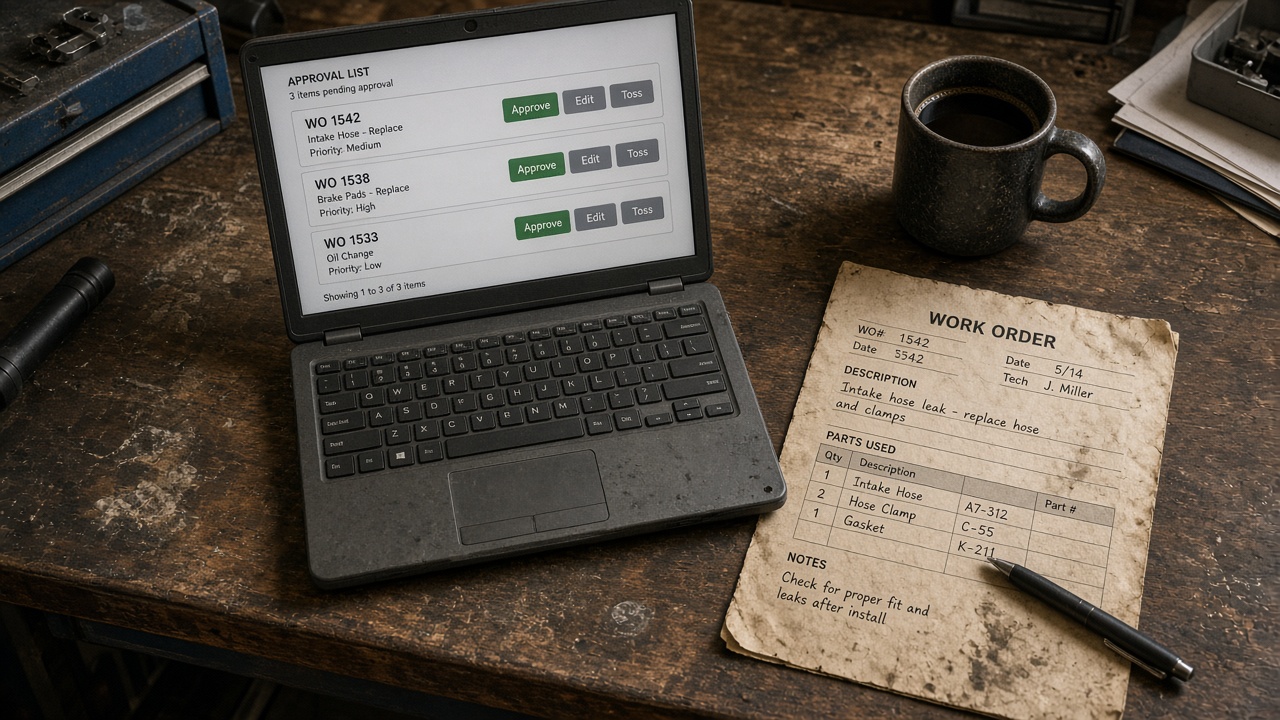
Keep Everything in One Approval List
The approval process was deliberately simple. Everything waited in one list. I reviewed each item and chose one of three outcomes:
- Approve: The draft is accurate, appropriate, and ready to use.
- Edit: The draft is useful, but the wording or details need correction.
- Toss: The draft is not suitable and should not go out.
The point is not to replace one pile of unfinished work with several scattered piles of AI drafts. It is to have one clear place where prepared work waits for a decision.
Approval also needs to mean something. Do not approve a message just because it looks professional. Read it for accuracy, tone, and any commitment it makes on behalf of the shop.
Nothing leaves without a human decision. That was the operating rule for the week, not an exception reserved for unusual situations. The agent could prepare work while I was busy, but it could not speak for the business without my OK.
Give the Agent the Shop Rules It Cannot Guess
AI does not know what you never told it. That includes your hours, your pricing rules, and the jobs your shop will not take.
Those details are basic to running the business, but they are not automatically available to an assistant. If they are missing, you can end up with a draft that sounds confident while failing to match how your shop operates.
Before handing off a task, make the relevant rules clear:
- Your operating hours.
- The pricing rules that affect customer communication.
- The types of work you do not accept.
- The requirement that outgoing messages wait for approval.
- The requirement that bookings remain under your control.
Then correct the drafts when they miss. If the tone is wrong, make that correction clear. If a response conflicts with a shop rule, point out the rule rather than only fixing the sentence.
The drafts can get closer as you provide guidance and corrections. That does not make checking optional. Better preparation helps the assistant do its job; it does not remove your responsibility for the result.
Keep Angry Customers and Money Under Human Review
The honest limitation is that drafts can miss the tone. That matters in any customer communication, and it matters even more when someone is upset.
An angry customer needs more than a response that sounds calm. You need to understand what happened and decide how your shop should handle it. AI can help prepare wording, but you should keep your own eyes on the situation.
The same applies to anything involving money. A draft that touches pricing or another financial issue deserves direct review. Do not let the convenience of a prepared message blur the boundary between writing assistance and a business decision.
This is not a reason to avoid AI. It is a reason to give it a sensible job. Let it help with the routine preparation while you stay responsible for sensitive conversations and commitments.
Start With One Job This Week
You do not need to hand over all five areas at once. Pick one job, such as review replies or estimate follow-ups, and hand off just that task.
Give the agent the relevant shop information. Have it prepare the drafts. Put those drafts in your approval list, then approve, edit, or toss each one.
Keep approving everything while you learn whether the drafts fit your business. Trust should come from reviewing the work, not from assuming that an AI tool must be right.
The practical question is whether the prepared work is useful. Does it reflect your rules? Does it sound like your shop? Can you make a clear decision about it before anything reaches a customer?
That is a manageable starting point for shop automation. You are not trying to rebuild the business around a tool. You are taking one recurring task off the blank-page stage while keeping control of the outcome.
Key Takeaways
- Use an AI agent for repair shops to prepare routine communication, not to make shop decisions.
- Keep every outgoing draft in one approval list for human review.
- Provide your hours, pricing rules, and limits on accepted work.
- Start with one task and personally review sensitive customer and money matters.
Want help setting this up? Request a free marketing analysis at americasbestshops.com. We’ll walk through your shop with you and help you decide where to start.

Brad Killgore is a Best Selling Author, Speaker, Military Veteran, and Strategic Marketing Expert with over 18 years of experience in the industry. Brad loves to spend time with his family and 3 grandchildren. He is an avid traveler who previously lived full-time with his wife in their luxury RV for 3 years. He has worked on some of the biggest concert stages in the world and met some of the most famous Rock Stars on the planet. Brad is a car and motorcycle enthusiast who has attended thousands of concerts over the last 45 years. Brad has been featured on top media outlets for his outstanding marketing results for America’s Best Shops. Brad is a Trailblazer in the world of AI strategy and automation.