Most of the marketing that brings cars into an independent shop isn’t fancy. It’s a complete Google Business Profile, a page on your website for each repair you want more of, a steady flow of honest reviews, a phone that gets answered, and a reason for past customers to come back. This guide walks through each piece in the order that usually pays back first, so you can put your time and money where it counts.
Key Takeaways
- Treat marketing as four jobs: getting found, getting the call answered, getting the yes, and getting the customer back.
- Keep your domain, website, and Google Business Profile in your own name, not a vendor’s.
- Fix the free basics (profile, service pages, reviews, phone) before you pay for ads.
- Past customers are usually your cheapest source of repeat work.
What auto repair shop marketing really means in 2026
It isn’t one tactic. It’s four jobs that happen in order, and when one breaks, the others can’t make up for it.
Why does local search matter so much?
When a car breaks down, many drivers grab their phone and search for a shop nearby. They scan a short list, check star ratings and distance, and call. If your shop isn’t on that list, or your listing looks incomplete, you don’t get a chance at the job.
What happens after the phone rings?
Being found is only the start. If calls go to voicemail, or the front counter has no consistent way to turn a question into an appointment, that visibility is wasted.
The fourth job, bringing customers back, is often the one that gets skipped. It has its own section below.
Where does AI fit?
AI and automation can help with the repetitive parts: drafting posts and service pages, asking for reviews, sending reminders, and texting back missed calls. They don’t replace good work or good people at the counter. They make the four jobs easier to keep up every week, not just when things slow down. For a deeper look at the online side, see how online marketing can grow your auto repair shop.
Own your shop online first (no lock-in)
Before you spend on anything else, make sure you own the pieces your marketing is built on. Your domain, your website, and your Google Business Profile should be in your name, under your login, not tied to an agency or a shop-management software account.
Why does ownership matter?
Reviews, rankings, and years of customer trust build up on those assets. If a vendor holds the domain or the profile login and you part ways, you may end up rebuilding from scratch instead of simply moving on. Marketing bundled into some shop software can create the same problem.
How do you check what you own?
- Log in to your Google Business Profile and confirm you’re listed as the owner, not just a manager.
- Check who the domain is registered to and that renewal notices go to you.
- Make sure you have admin access to your website and any ad accounts.
A good marketing partner should be happy to work inside accounts you own.
Your Google Business Profile: the front door
For a local repair shop, your Google Business Profile is often the first thing a driver sees, before your website. It shows your name, phone number, hours, address, photos, and reviews right in search results and on Google Maps. If it’s missing details or out of date, drivers move on to the next listing.
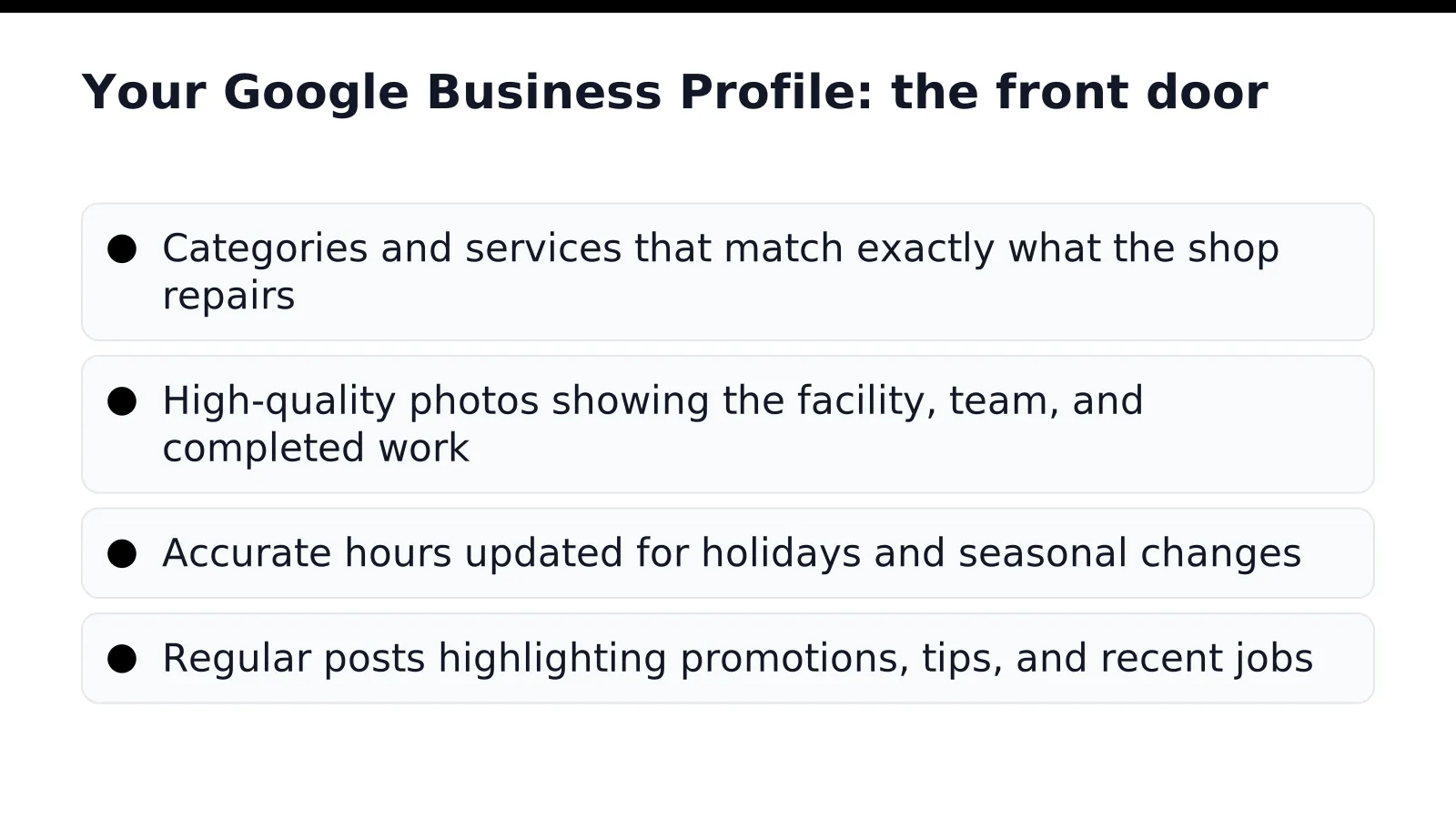
What makes a profile complete?
- Primary and secondary categories, plus services, that match what you actually repair
- Real photos of the shop, the team, and finished work
- Accurate hours, including holidays
- Regular posts with tips, seasonal reminders, or recent jobs
Does this apply to motorcycle and specialty shops?
Yes. Motorcycle, RV, truck, and specialty shops depend on the same profile basics. Riders searching for “motorcycle repair near me” can only call the shops they can find.
A quick weekly check of your phone number, website link, hours, and unanswered reviews keeps the profile working for you. For a step-by-step setup guide, see Auto Repair Shop SEO: How to Show Up on Google and Google Maps.
A website that turns searches into booked appointments
Drivers searching for “brake repair near me” or “check engine light diagnosis” want to know one thing: can this shop fix my problem? A page on your site for each repair you want more of answers that question better than one general “Services” page that lists everything.
What should a service page include?
- What the repair is and the common signs a driver might notice
- The vehicles you work on
- What to expect: how you diagnose, how you quote, and how you get approval before work starts
- A clear phone number and a booking button near the top
How do service pages help you show up in search?
A page focused on one repair tells search engines what you do and where you do it. Match the services listed on your profile to those pages, so drivers see the same story from search to appointment.
Start with your highest-margin or most-requested repairs, then add pages over time.
Reviews: getting more and answering them
Reviews are often what tips a driver from looking to calling. Many people skim a few of the newest reviews before they pick a shop, so reviews that keep coming in tend to count for more than a big pile of old ones.
How do you get more reviews without being pushy?
- Ask every customer in person at pickup, while the visit is fresh.
- Follow up with a text that includes a direct review link.
- Make it part of the routine for every completed job, not an occasional push.
Don’t offer discounts or gifts in exchange for reviews. Google’s review policy doesn’t allow it.
Should you reply to negative reviews?
Yes. A calm, specific reply that acknowledges the issue and offers to make it right shows future customers how you handle problems. Keep it short, skip the arguing, and take the details offline. Reply to good reviews too. A simple thank-you that mentions the work shows real people are behind the shop.
Local Services Ads (LSA) and other paid ads: when they pay off
Paid ads work best once the basics above are in place. If your profile is thin, your service pages are missing, or calls go unanswered, ad clicks leak away.
Do paid ads work for small shops?
They can. Google’s LSA and search ads can place your shop at or near the top of results while drivers are actively looking. The ad gets the click. Your reviews, profile, and phone handling decide whether that click becomes a booked job.
What order should you do things in?
| Stage | What to do | Why it comes first |
|---|---|---|
| Foundation | Profile, service pages, reviews, answered calls | Turns paid clicks into booked work |
| Paid | LSA, search ads | Reaches drivers who are searching now |
Start small, track which ads lead to calls and booked work, and only spend more on what’s working.
Answer every call: missed-call text-back and after-hours coverage
An unanswered call is an easy way to lose a job. A driver with a grinding brake will often call the next shop on the list if nobody picks up. Fixing call handling usually costs less than buying more ads.
What does missed-call text-back do?
When a call goes unanswered, missed-call text-back sends an automatic text right away, something like “Sorry we missed you. How can we help?” That keeps the conversation going while you’re under a car or after you’ve closed. Here are some AI prompts that help with customer messages.
How do you cover after-hours calls?
- Missed-call text-back for calls you can’t get to
- An AI receptionist or answering service that handles common questions and booking requests
- Online booking so drivers can pick a time themselves
Whatever you use, test it: call your own shop after hours and see what a customer experiences. For more, read about handling missed calls and after-hours coverage.
Follow up on quotes and get written approvals
An estimate that sits unanswered is a bay that may sit empty. Treat every quote as a live lead until you get a clear yes or no.
- Text the estimate with a clear total and what’s included.
- Ask for a written yes, not just a verbal OK on the phone.
- Save the approval to the repair order.
- Follow up once if the customer goes quiet.
How do you turn more quotes into booked jobs?
Follow up quickly, while the problem is still on the customer’s mind. Photos or video from a digital inspection help customers understand what they’re approving. Simple templates or an AI agent for repair shops can draft follow-up messages so your service writers don’t start from scratch.
Why do written approvals matter?
A texted approval saved to the repair order gives you a clear record if there’s a disagreement about the bill later. It also sets expectations with the customer up front, which builds trust.
Bring back past customers before you discount
Your past customers already know you, so bringing them back usually costs less than finding new ones. Before you reach for discounts, make sure you’re reminding people when service is due.
How do you bring customers back without cutting prices?
Set up automated service reminders based on mileage or time since the last visit. Use inspection reports to note items that can wait, then remind the customer when it’s time. A short, friendly message from a shop they trust often works better than a coupon.
Why do reminders often beat discounts?
A reminder arrives when maintenance is due. A discount teaches customers to wait for the next deal. Staying in touch with existing customers helps protect your margins.
Showing up in AI search (ChatGPT, Google AI)
Some drivers now ask AI tools like ChatGPT, or read Google’s AI Overviews, when they look for a shop. Instead of a list of links, they often get a short answer that names a few businesses. You want your shop to be one of them.
How is AI search different?
AI tools pull information from many places: your website, your Google profile, reviews, and directories. Shops with clear, consistent, detailed information are easier for these tools to understand and recommend.
What helps your shop show up in AI answers?
- Clear service pages that explain what you do, for which vehicles, and where
- The same name, address, phone, and hours everywhere you’re listed
- Recent, detailed reviews that mention the work you did
- Helpful answers to common customer questions on your site
These are the same basics that help in regular search, so you aren’t starting over. Read more about how repair shops show up in AI search.
A simple 30-day marketing checklist for shop owners
If this feels like a lot, spread it over a month. Each week takes a few focused hours.
Week 1: Foundation
- Claim and fully complete your Google Business Profile
- Add real photos of the shop inside and out, plus the team
- Check business hours, phone number, and service categories
Week 2: Reviews
- Ask a handful of recent customers for a review by text or email
- Reply to every existing review, good or bad
- Look at nearby shops’ profiles for services they list that you don’t
Week 3: Content
- Publish one service page for your highest-margin repair
- Post a few profile updates with photos of real work
- Use AI prompts to draft a month of social media captions, then edit them in your own words
Week 4: Automation
- Set up automated service reminders for returning customers
- Turn on missed-call text-back
- Look at what brought in calls and booked work, and plan the next 30 days
FAQ: questions shop owners ask
What separates growing repair shops from shops that stay the same size?
Usually consistency. Good work earns word of mouth, and shops that keep up the four jobs every week, not just when it’s slow, give that reputation more chances to turn into booked jobs.
How do I know which marketing is working?
Ask every new customer how they found you and note it on the repair order. Compare that with the calls and website clicks in your profile’s performance report and your ad accounts once a month, then put more time into what’s bringing in work.
In Closing
Good shop marketing comes down to the four jobs, done a little every week. Pick one week of the checklist and start there. If you’d like a second set of eyes, America’s Best Shops can put together a free marketing analysis for your shop.

Brad Killgore is a Best Selling Author, Speaker, Military Veteran, and Strategic Marketing Expert with over 18 years of experience in the industry. Brad loves to spend time with his family and 3 grandchildren. He is an avid traveler who previously lived full-time with his wife in their luxury RV for 3 years. He has worked on some of the biggest concert stages in the world and met some of the most famous Rock Stars on the planet. Brad is a car and motorcycle enthusiast who has attended thousands of concerts over the last 45 years. Brad has been featured on top media outlets for his outstanding marketing results for America’s Best Shops. Brad is a Trailblazer in the world of AI strategy and automation.