
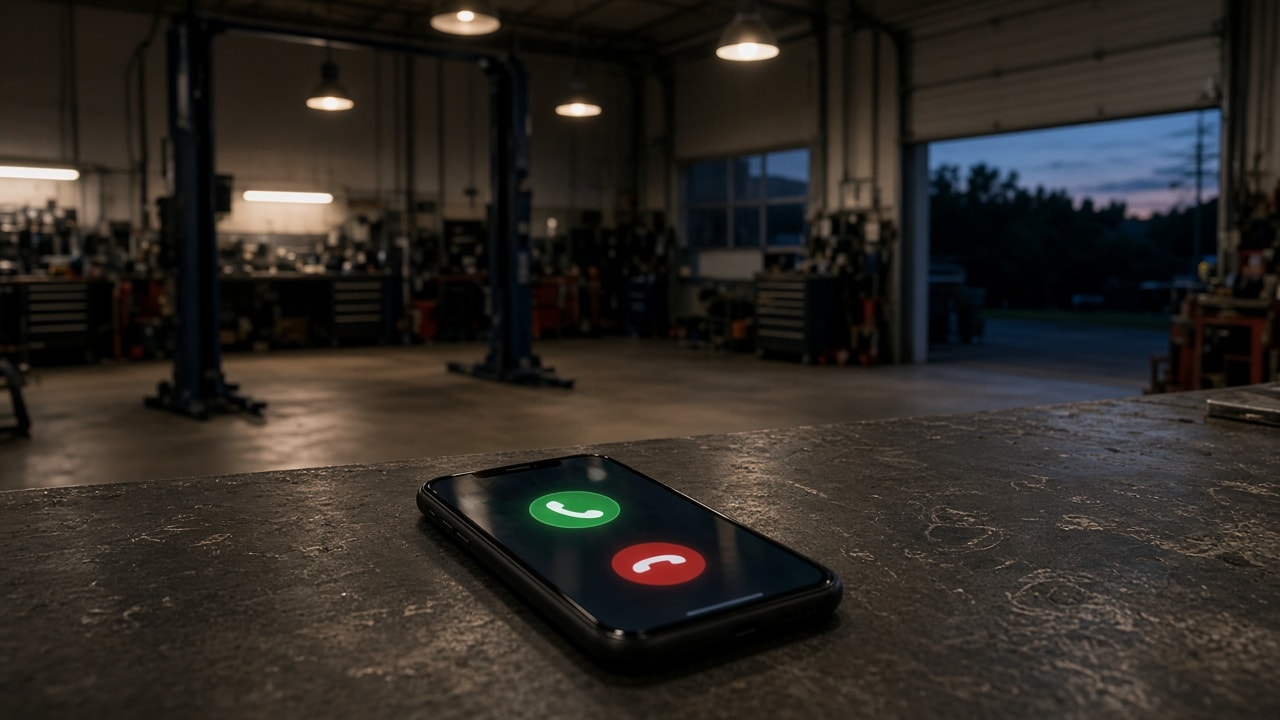
Friday, 6:05 p.m. A driver with a warning light calls your repair shop. The phone rings out. They call the next shop on the list. If missed calls are costing your repair shop jobs, this guide shows how to book those callers instead.
Monday morning, you have an empty bay. Nobody on your team knows that job was ever available.
The service advisor was wrapping up. The technicians were putting tools away. Nobody ignored the caller on purpose. Your shop was closed, and the driver needed somebody who could respond.
That is what makes missed calls such a frustrating leak. You can do the work to get found, earn the phone call, and still lose the opportunity before a conversation ever starts.
The answer is not another dashboard or a complete overhaul of your front counter. It is a simple safety net under your phone: catch the missed call, respond quickly, and give the caller a clear path to a real appointment.
Key Takeaways
- Missed-call text-back creates a conversation when your team cannot answer the phone.
- After-hours assistants need clear disclosure, real calendar availability, and reliable human handoffs.
- Start with a narrow capture layer and expand only when booked appointments justify it.
- Review conversations, bookings, routing rules, and texting consent every week.
Table of Contents
- The Invisible Leak in Your Repair Shop
- Three Layers of Missed-Call Coverage
- Start Small Without Burying the Front Desk
- Step One: Audit Your Phone Before Buying Anything
- Step Two: Configure the Capture Layer and Test It
- Step Three: Review Conversations and Bookings Every Week
- Recover Opportunities Without Promising Results
The Invisible Leak in Your Repair Shop
Vehicle repair is still a phone business. When a check engine light appears or a brake starts grinding, the driver wants help, not another task. Calling a shop is often their quickest way to find it.
If that call reaches voicemail, many people do not leave a message. They move to the next number within seconds. Their problem feels urgent, and silence gives them no reason to wait.
The broad small-business figures underline the problem: roughly four in ten calls reach a live person, nearly three in ten arrive outside normal business hours, and about a third of those after-hours callers are ready to spend money. Those are not measurements of your particular shop, but they are a reason to check your own coverage.
This is not necessarily a marketing failure or a customer-service failure. It is a gap between someone asking for help and your team being available to respond.
During business hours, that gap can open while your advisor is helping the customer standing at the counter. After hours, it opens because everyone has gone home.
The opportunity may never become a customer record or an appointment request. Even if the phone system logs the number, your team may have no useful context about the job. Later, the loss looks like unused capacity rather than a missed conversation.
Before you buy more attention, make sure you can catch the attention you already earned.
Three Layers of Missed-Call Coverage
A practical missed-call system has three layers. You do not need all three on day one. The first does much of the heavy lifting, and the others should earn their place.
1. Missed-Call Text-Back
When a call is not answered, the caller receives a short text acknowledging the call and offering help. Instead of leaving them at a dead end, you open a conversation.
The message should do one of two things:
- Offer a booking link connected to actual availability.
- Ask a plain question about the vehicle and the service it needs.
Keep it short. The caller does not need your entire service menu or a long introduction. They need to know the shop received their call and that there is a useful next step.
Asking about the vehicle and the problem gives your advisor something to work with. Offering a booking link lets a suitable caller move toward an appointment without waiting for another phone conversation.
This is the smallest useful layer because it helps during a busy morning as well as after closing. Your advisor can finish helping the person at the counter without losing all contact with the person on the phone.
It does not remove the need for human follow-up. It buys you a chance to have that conversation.
2. Optional After-Hours Answering
If you want calls answered while the shop is closed, an AI voice assistant can handle the initial conversation. It should clearly identify itself as an assistant, then ask the basic questions your service advisor would ask.
Professional voice AI systems can handle multiple calls simultaneously. Some can support capacity on the order of 200 concurrent lines, depending on the system. Most individual shops will not need anything close to that. The useful point is that incoming calls do not have to queue behind one person.
Capacity alone is not the goal, though. The assistant needs access to a real calendar with real open slots. Otherwise, it is only taking a message with a more elaborate greeting.
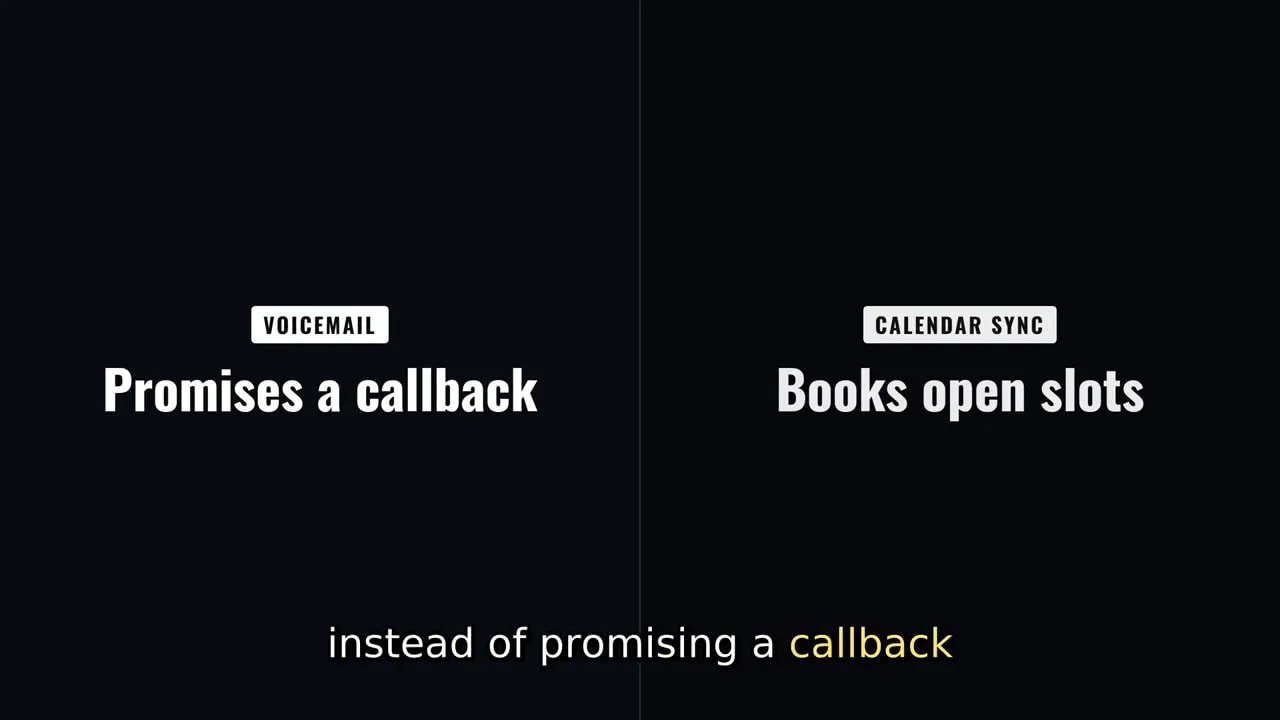
There also needs to be a clear route to a human when the situation calls for one. An assistant should not trap a frustrated customer in a loop or keep handling a call that your rules say belongs with a person.
3. Consent-Based Follow-Up
Once someone has reached out, a simple text sequence can help maintain the conversation, confirm an appointment, and send a reminder.
This is not a blast to a purchased list. It is follow-up tied to an actual inquiry, handled under the consent and privacy rules that apply to your shop.
The distinction matters. Someone contacting your business is not a blank check for unlimited messaging. Keep the follow-up relevant to their request and get the rules right before turning it on.
Across all three layers, speed matters. A useful response within a few minutes gives you a better chance to continue the conversation than a response hours later. You are not trying to outspend a giant competitor. You are trying to respond before voicemail sends the job elsewhere.
Start Small Without Burying the Front Desk
Picture the counter at 10:15 on a Tuesday. Two customers are waiting. A technician wants a parts ETA. The phone lights up again.
Your advisor is not lazy or careless. They are already doing several jobs at once. Adding a complicated software stack can make that morning harder instead of easier.
So do not start by replacing everything. Start with missed-call text-back and fast human follow-up. Let that narrow layer catch a call while your advisor stays focused on the customer in front of them.
If after-hours answering makes sense later, add it with clear assistant disclosure and a simple human handoff. Your service advisor still owns the relationship and closes the job.
The test is not whether the technology feels impressive. It is whether it helps turn otherwise lost inquiries into booked appointments without creating unnecessary work.
Setup can often take around three business days where applicable, but that is not a universal promise. Judge the system over roughly two months, not two days. Start small, correct the rules, and expand only when the results justify another layer.
Step One: Audit Your Phone Before Buying Anything
The first job is to describe how your shop actually operates. Automation needs your operating rules, not a generic script that could belong to any business.
Write down:
- Your real hours: when your team can answer and when the shop is closed.
- Your service area: where you can realistically help customers.
- Call ownership: who answers which inquiries and who handles follow-up.
- Qualifying questions: the information needed to understand whether the request fits.
- Emergency and handoff rules: which situations must go to a person.
- Booking availability: which actual schedule openings can be offered.
Keep the qualifying questions focused. Vehicle year and make, mileage, warning lights, the service concern, and how soon the driver needs an appointment are useful starting points.
You are gathering enough context for the next step, not trying to make every caller complete an exhaustive intake process. A short, clear exchange is better than a long sequence that people abandon.
Pay particular attention to handoffs. Knowing when automation must stop matters more than polishing every sentence it says. Define what goes directly to a person and who that person is before the first real customer uses the system.
Then connect the booking process to your actual calendar. An appointment should mean a real slot on your schedule, not a request that someone still has to find room for later.
If the availability is not real, the system has not solved the problem. It has moved the uncertainty from the phone to the front desk.
Step Two: Configure the Capture Layer and Test It
Turn on the missed-call text-back with a short, plain message and a clear next step. Make sure it behaves the way your team expects when a call slips through.
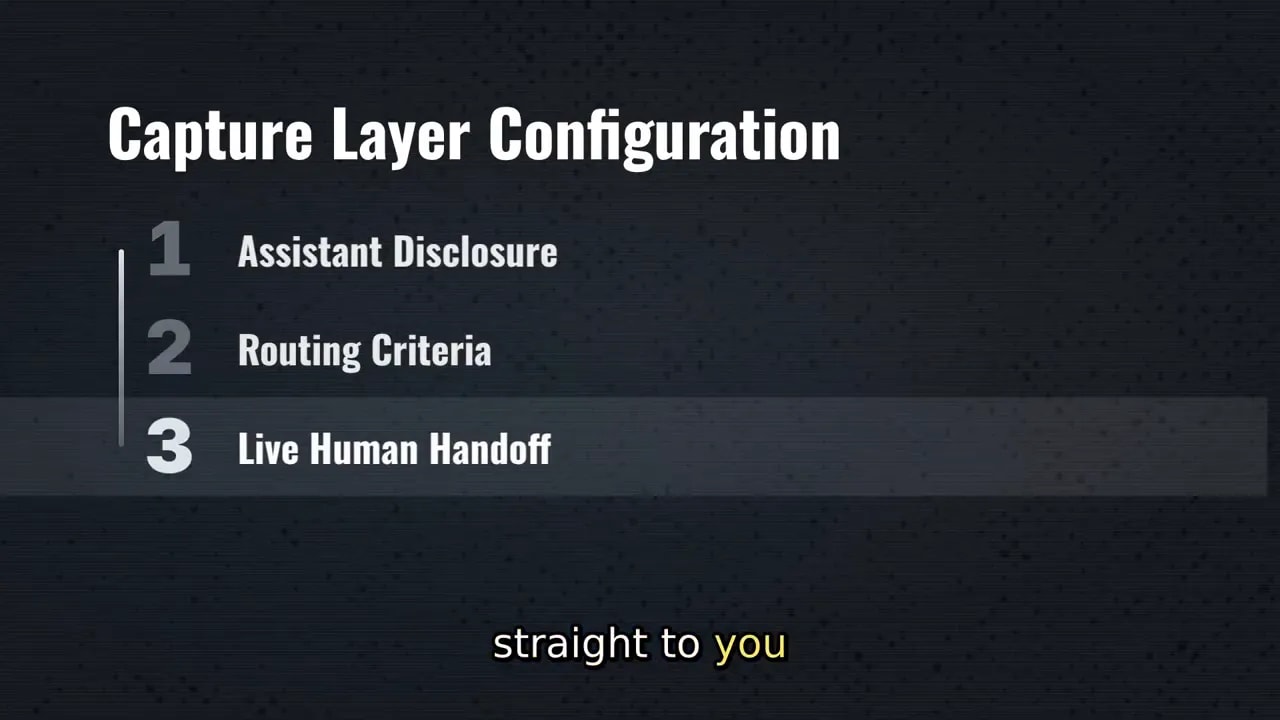
If you add voice answering, configure three things deliberately:
- Assistant disclosure: the greeting clearly explains that the caller is speaking with an assistant.
- Routing criteria: the system knows when it can continue and when the call needs another path.
- Live human handoff: the caller has a straightforward way to reach a person when appropriate.
Do not stop after one easy test call. Try the situations that are most likely to expose weak rules:
- A driver calling about a brake problem at 9 p.m.
- A wrong number.
- A caller who needs a language handoff.
- An angry caller who demands a real person.
Check the whole path, not just the greeting. Does the system gather useful information? Does it recognize a handoff situation? Does the booking land in a genuine opening? Can your advisor understand what happened afterward?
Something will break during testing. That is the point. Finding a weak routing rule with your own test call is better than discovering it through a frustrated customer.
Fix the problem, then run the scenario again. A feature being enabled is not the same as a workflow being ready.
Step Three: Review Conversations and Bookings Every Week
This is the step many shops skip. They set up the tool, see messages moving, and assume the job is done.
But the scripts and routing rules are what make the system useful. They improve with a little regular attention.
Focus the weekly review on two primary measures:
- Conversations: whether missed inquiries become actual exchanges with potential customers.
- Booked appointments: whether those exchanges lead to real slots on the schedule.
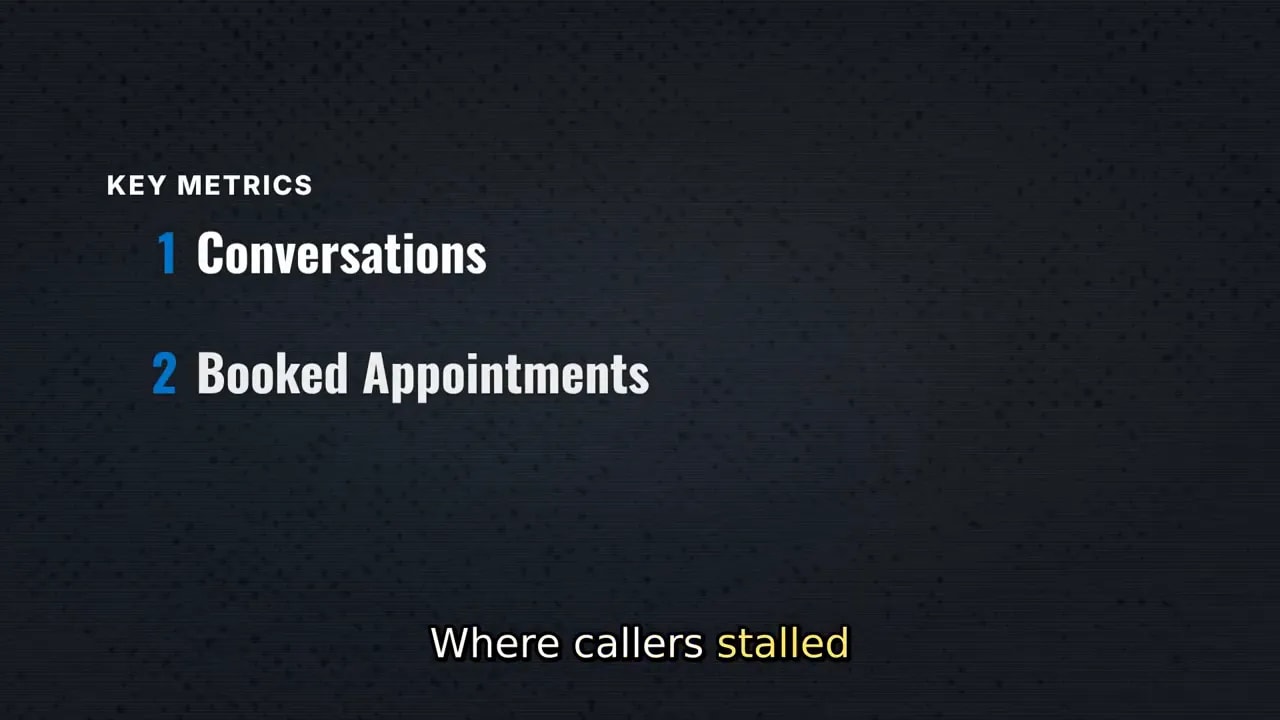
Ignore how busy the dashboard feels. Activity is not the same as progress. A stream of automated messages does not mean much if callers stop responding or no suitable appointments get booked.
Look at where the process stalls. If callers drop out after a question, review the wording. If a human handoff fails, adjust the rule. If an inquiry reaches the team without enough context, revisit the qualifying questions.
Make the changes small and tied to an actual problem. The goal is not to rewrite everything every week. It is to remove the friction that real conversations reveal.
Keep Consent and Privacy in the Review
Texting rules are part of the setup and the ongoing review, not something to think about after a complaint. Follow the consent and privacy requirements that apply in your area.
For U.S. shops, the FCC’s information on telemarketing and robocalls provides supporting context. Confirm the requirements for your specific texting and calling workflow rather than assuming every kind of follow-up is treated the same way.
A text to someone who never asked for one is a problem, not a lead. Keep the system focused on appropriate responses to genuine inquiries, with consent handled properly.
Recover Opportunities Without Promising Results
Be honest about what this system can do. It is built to recover opportunities your shop was already receiving. It does not guarantee a single booking.
Not every caller will respond. Not every vehicle or service request will fit. Not every conversation will turn into work. Anyone promising otherwise is selling certainty they cannot deliver.
The useful outcome is simpler. Imagine opening your phone Monday morning and finding a short list of overnight conversations. Two requests fit your shop, and both have appointments in actual openings. Your team starts with context instead of chasing unknown numbers.
That is the aim: fewer opportunities disappearing before your service advisor can help.
Audit the phone, start with the smallest capture layer, test the difficult calls, and review the bookings each week. You do not need to turn your repair shop into a technology company. You need to give the next good caller somewhere to go besides the next shop.
Need help setting this up for your shop? America’s Best Shops helps vehicle repair shops turn missed calls into booked appointments. Book a free strategy call at https://americasbestshops.com/

Brad Killgore is a Best Selling Author, Speaker, Military Veteran, and Strategic Marketing Expert with over 18 years of experience in the industry. Brad loves to spend time with his family and 3 grandchildren. He is an avid traveler who previously lived full-time with his wife in their luxury RV for 3 years. He has worked on some of the biggest concert stages in the world and met some of the most famous Rock Stars on the planet. Brad is a car and motorcycle enthusiast who has attended thousands of concerts over the last 45 years. Brad has been featured on top media outlets for his outstanding marketing results for America’s Best Shops. Brad is a Trailblazer in the world of AI strategy and automation.